
Failing your MOT can be stressful. After all, it’s not just about ticking a legal box; it’s about knowing whether your car is safe to be on the road. At Service4Service, we help drivers across the UK compare garages and understand what a failed MOT really means for their vehicle and their driving options.
When your car fails its MOT, the immediate question is often: “Can I still drive it?” The answer isn’t a simple yes or no, because it depends on the nature of the failure and the circumstances under which you intend to drive the car.
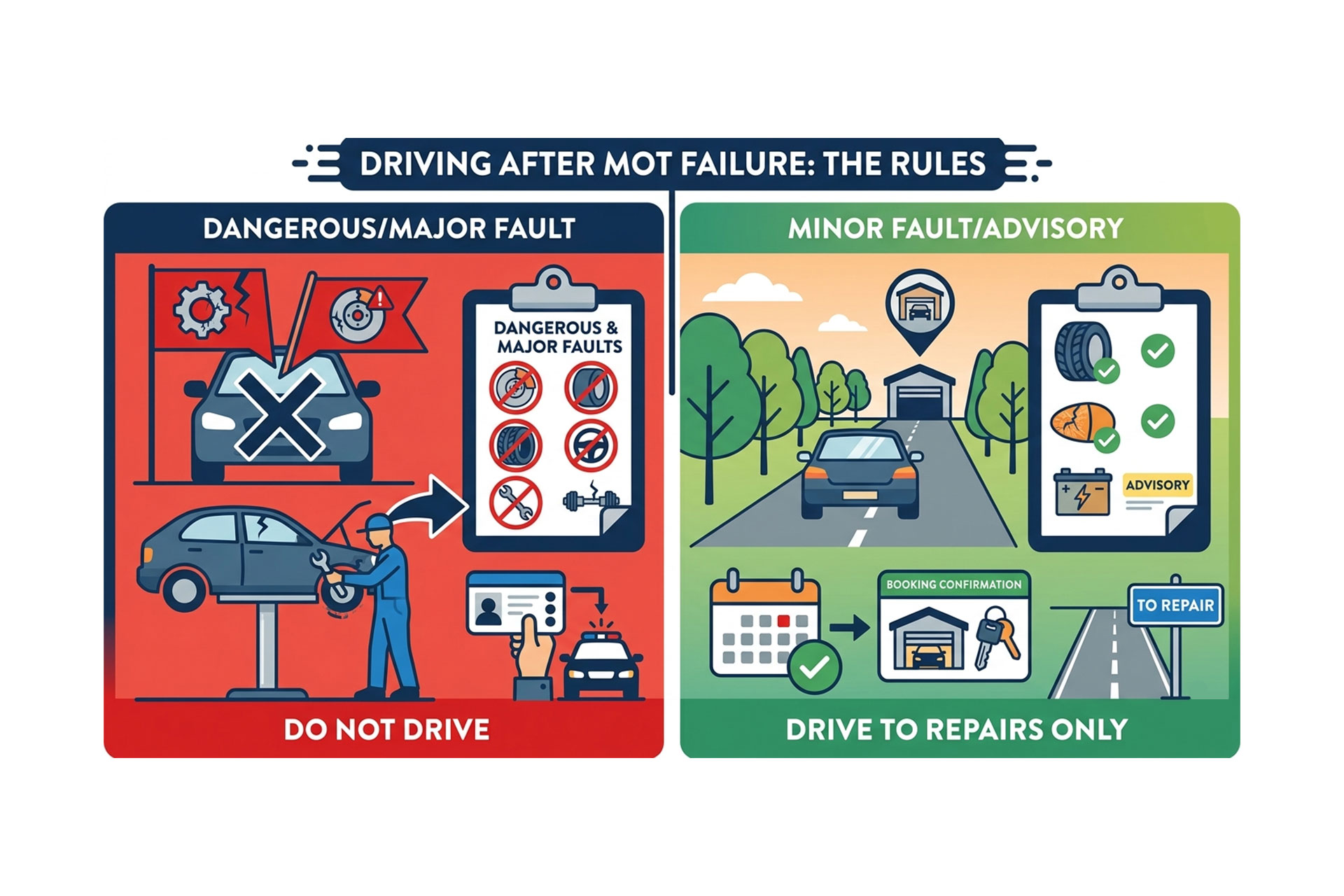
Some faults are considered “dangerous” or “major,” while others are “advisory” or “minor.” Dangerous and major faults are serious enough that your car should not be driven until repairs are made. These can include brake failure, steering issues, serious suspension damage, or worn tyres. Driving in this condition is illegal and could put both you and other road users at significant risk. If caught driving with a dangerous MOT failure, you could face fines, points on your license, and insurance issues.
However, minor faults or advisories do not usually prevent you from driving the car legally. Advisory notes are often recommendations to monitor or fix a part soon, but aren’t considered immediately unsafe. This distinction can be confusing, which is why understanding your MOT report is crucial. The certificate itself will clearly mark any dangerous or major failures that must be addressed before driving again.
There are specific situations where driving a car after a failed MOT is legally allowed. For example, you can drive to a pre-booked garage to carry out the necessary repairs, or to a testing centre if you need to retake the MOT. In these cases, it’s important to go directly to the destination, avoid unnecessary trips, and ensure the vehicle is as safe as possible before setting off.
Even if the law technically allows driving after a minor failure, it’s worth considering the potential risks. Advisory issues can sometimes escalate faster than expected. A worn tyre might still pass the test superficially but could fail under wet conditions or high-speed driving. Ignoring advisory notes could lead to a more serious problem and a larger repair bill later.
When faced with an MOT failure, timely repairs are the best way to protect your car and your budget. Using a comparison site like Service4Service makes it easy to find a local garage, compare prices, and understand exactly what the service includes. Rather than guessing which repair is urgent and which can wait, you can make an informed choice and ensure your car is safe and roadworthy as soon as possible.
Another point many drivers overlook is the relationship between MOT failures and insurance. Driving with a known dangerous fault could invalidate your coverage in the event of an accident. Even for minor advisories, insurers may take into account whether your vehicle was being maintained responsibly. This adds another layer of risk if you ignore MOT issues or attempt to drive without addressing them promptly.
Ultimately, failing an MOT isn’t the end of the road. It’s a warning system that identifies issues before they become serious. The key is to understand the severity of the faults listed, act quickly, and use trusted garages to carry out the necessary work. Comparing quotes and services through a platform like Service4Service gives you peace of mind, competitive pricing, and clarity about what each repair entails.
So, can you drive after an MOT failure? The answer depends on the type of fault. Dangerous and major issues require immediate attention and mean the car should stay off the road until repaired. Minor faults allow for cautious driving, often to a garage for repairs. In all cases, the safest approach is to address faults quickly and ensure your vehicle is fully roadworthy. That way, you protect yourself, other road users, and your car’s long-term reliability.
 Steve
Steve