
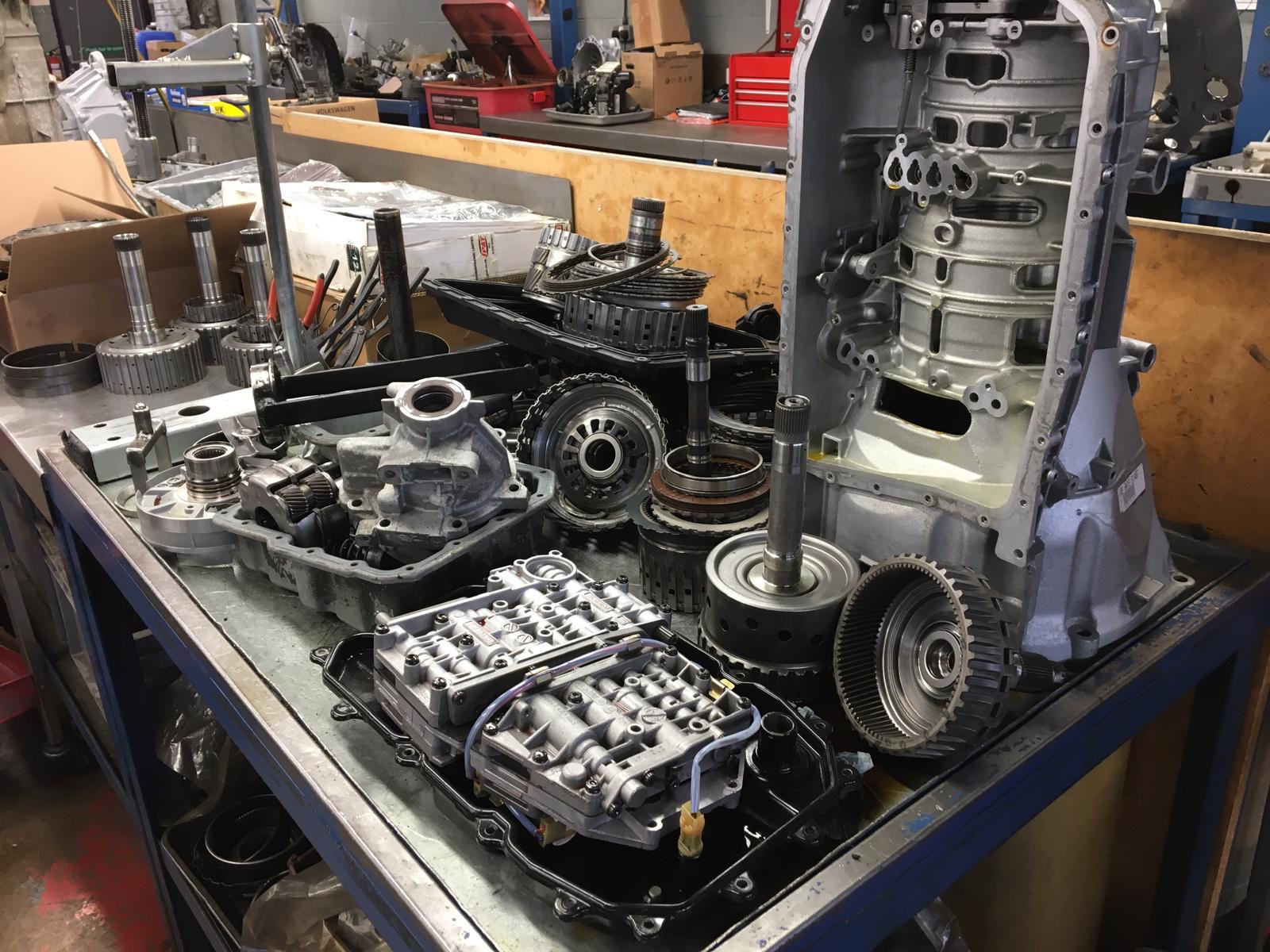
Both are described as automatic, because neither requires you to change gear manually. But a traditional automatic gearbox and a CVT work on entirely different mechanical principles, fail in different ways, and need different maintenance to stay in good condition.
If you are trying to understand what type of transmission your car has, what the implications are for reliability, or why a specialist is recommending one type of repair over another, this post covers the differences clearly.
How a Traditional Automatic Gearbox Works
A traditional automatic, in its most common form, uses a torque converter and a set of planetary gear sets to deliver a defined number of fixed gear ratios. Modern vehicles typically have six, eight or even ten fixed ratios. The torque converter connects the engine to the gearbox and allows the car to sit in drive at idle without stalling. As speed and load conditions change, the gearbox selects the appropriate gear ratio using hydraulic pressure controlled by solenoids and the valve body.
The driver experiences this as a series of distinct gear changes, even if they are smooth. The gearbox steps from first to second to third and so on, selecting the ratio the transmission control unit calculates is most appropriate for the conditions.
How a CVT Works
A CVT, which stands for continuously variable transmission, has no fixed gear ratios. Instead of stepping between ratios like a traditional automatic, it adjusts the ratio continuously and seamlessly across the full speed range. It does this using a steel belt or chain running between two variable-diameter pulleys. When the pulleys change their effective diameter by moving in or out under hydraulic pressure, the ratio changes. There is no step, no gear change, and no point at which the gearbox selects one ratio and holds it.
The result is that the engine can run at its most efficient RPM regardless of vehicle speed, which is why CVTs are common in hybrid and economy-focused vehicles. From the driver’s perspective, the engine note stays broadly consistent during acceleration rather than rising and falling through gear changes.
Dual-Clutch Automatics: A Third Type Worth Knowing
Dual-clutch transmissions, including DSG, S-Tronic and PDK, are a third type that is technically not a traditional automatic and not a CVT. They use two separate clutch packs, one for odd gears and one for even gears, to pre-select the next gear while still in the current one. This allows very fast, seamless gear changes without the brief interruption in power delivery that a conventional automatic produces.
Dual-clutch units are common in performance-oriented vehicles and in many mainstream European cars. They have their own specific failure modes and service requirements, which are different from both traditional automatics and CVTs.
Key Differences for the Driver
Driving Feel
A traditional automatic delivers its gear changes as a series of smooth but perceptible transitions. A well-set-up eight-speed torque converter automatic is very smooth, but the gear steps are still there if you are paying attention. A CVT is genuinely seamless, which some drivers find comfortable and others find peculiar because the engine note does not correspond to gear changes in the way they expect.
Efficiency
CVTs are generally more fuel-efficient in urban driving because they keep the engine in its most efficient operating range. Traditional automatics have become increasingly efficient with higher numbers of ratios, and modern eight and ten-speed units are competitive with CVTs on economy. The efficiency advantage of a CVT is most pronounced in stop-start city driving.
Performance
Under hard acceleration, a CVT’s ability to hold the engine at peak power RPM throughout the acceleration run is theoretically advantageous. In practice, many drivers find the sensation of the engine revving hard without corresponding changes in engine note or vehicle behaviour disconcerting. Dual-clutch automatics are generally the fastest in outright performance terms because they pre-select gears and change with almost no delay.
Key Differences for Maintenance and Repair
Fluid Type
Traditional automatics use automatic transmission fluid (ATF), which varies in specification by vehicle and gearbox type. CVTs use a specifically formulated CVT fluid that is not interchangeable with ATF. Using the wrong fluid type in either causes damage. Always use the fluid specified for the specific transmission fitted to your vehicle.
Service Intervals
Both benefit from regular fluid changes that manufacturers frequently underspecify. Traditional automatics generally benefit from a fluid service every 40,000 to 60,000 miles. CVTs benefit from a fluid change at similar intervals, with some manufacturers recommending closer to 40,000 miles. Sealed-for-life specifications on either type have not proven reliable in practice.
Common Failure Modes
Traditional automatics most commonly develop solenoid faults, valve body wear, clutch pack wear and torque converter problems. CVTs most commonly suffer from belt or chain wear, pulley wear, overheating and hydraulic pressure issues. The symptoms overlap in some cases, which is why a diagnostic rather than a symptom-based assumption is the correct starting point for any repair.
Repairability
Both types can be repaired. Traditional automatics have a longer history in specialist workshops and a wider availability of parts in some cases. CVT repair requires specific knowledge of these units and access to the correct parts and fluid specifications. Not every workshop has equal experience with both. For more on CVT repair specifically, see our post on CVT gearbox problems. For traditional automatics, the relevant posts by make cover the specific units most commonly seen in specialist workshops.
Which Is More Reliable?
This is a question with no universal answer, because both types have examples of excellent and poor reliability depending on the specific unit, the vehicle it is fitted to, how the car has been driven, and whether the transmission has been maintained correctly.
CVTs fitted to vehicles that have had regular fluid changes and have not been subjected to sustained towing or repeated hard acceleration tend to have good longevity. CVTs in vehicles that have never had a fluid change, or that have been driven heavily, tend to develop problems earlier. The same pattern applies to traditional automatics.
The most important variable is not the type of gearbox. It is how the gearbox has been maintained.
Frequently Asked Questions
What is the difference between an automatic and a CVT gearbox?
A traditional automatic uses a set number of fixed gear ratios, stepping between them as speed and load conditions change. A CVT uses a belt and pulley system to vary the gear ratio continuously, with no distinct gear steps. Both are operated without a clutch pedal or gear lever, which is why both are described as automatic. They differ significantly in how they work, how they fail, and what maintenance they need.
Is a CVT better than a traditional automatic?
Neither is categorically better. CVTs are more efficient in stop-start urban driving and keep the engine in its most efficient RPM range. Traditional automatics, particularly modern eight and ten-speed units, are smooth, well-proven, and in many cases very fuel-efficient. The best transmission for any given vehicle is the one designed and specified for it. Whether a CVT or a traditional automatic suits a driver better often comes down to whether they mind the driving character of a CVT.
Do CVTs last as long as traditional automatics?
A well-maintained CVT in normal driving can last as long as a well-maintained traditional automatic. CVTs that have not had fluid changes, or that have been used for sustained towing or repeated hard driving, tend to develop problems earlier than equivalent traditional automatics used the same way. Maintenance history is the biggest differentiating factor.
Can a CVT be repaired if it develops a fault?
Yes. CVT faults including fluid issues, solenoid problems, belt wear and pulley wear are all repairable. The repair approach depends on what has failed and how far the fault has progressed. A diagnostic identifies the specific cause before any repair is recommended. For a more detailed guide to CVT faults, see our post on CVT gearbox problems.
What fluid does a CVT use? Is it the same as an automatic?
No. CVT fluid is a different formulation to automatic transmission fluid and the two are not interchangeable. Using ATF in a CVT, or the wrong CVT fluid specification, causes rapid deterioration of the belt and pulleys. Always use the fluid specified for the exact transmission fitted to your vehicle.
If you have questions about your automatic or CVT gearbox, or need it diagnosed and repaired, call Service4Service on 0808 164 0418 for honest advice and a same-day response. Visit service4service.co.uk/car-repairs/gearboxes to find out more about the repair service, or send an enquiry at service4service.co.uk/car-repairs/gearboxes/make-an-enquiry.
 Ellis
Ellis